Innovative Cork Stoppers New to the Marketplace
Sustainable and taint-free corks are the latest innovations to hit the ‘spirit stoppers’ market.  Distillery by-products such as grape marc from cognac, barley malt from whisky and juniper from gin make up 50% of the raw materials used to produce ‘Abor’ corks.  Manufacturers, the Tapi Group, are “seeking to create brand awareness in an eco-sustainable way” with their ‘green’ and sustainable new closures.  Cork Supply, by contrast, have just released a range of ‘taint-free’ corks with a money-back guarantee.  Their vision was to “produce quality closures that add value to the industry”; taint-free cork stoppers will surely have a place… Read more

The Charente Scene – Bisquit Sold

Alexandre Bisquit established his famous cognac trading house in Jarnac in 1819.  When his daughter married Adrien Dubouché in 1848, his son-in-law’s name was added to the firm. It remained in family hands until the mid-60s when it was sold to Paul Ricard.  Latterly it was owned by Distell but earlier this year it was sold again, to the Campari group, for over 50 million Euros.  In many ways the purchase of Bisquit Dubouché by M. Ricard was the start of the firm’s real growth.  Not only did he buy the biggest chateau in the region, with more than 200… Read more

The Bottle Story – Renault Avec Cognac

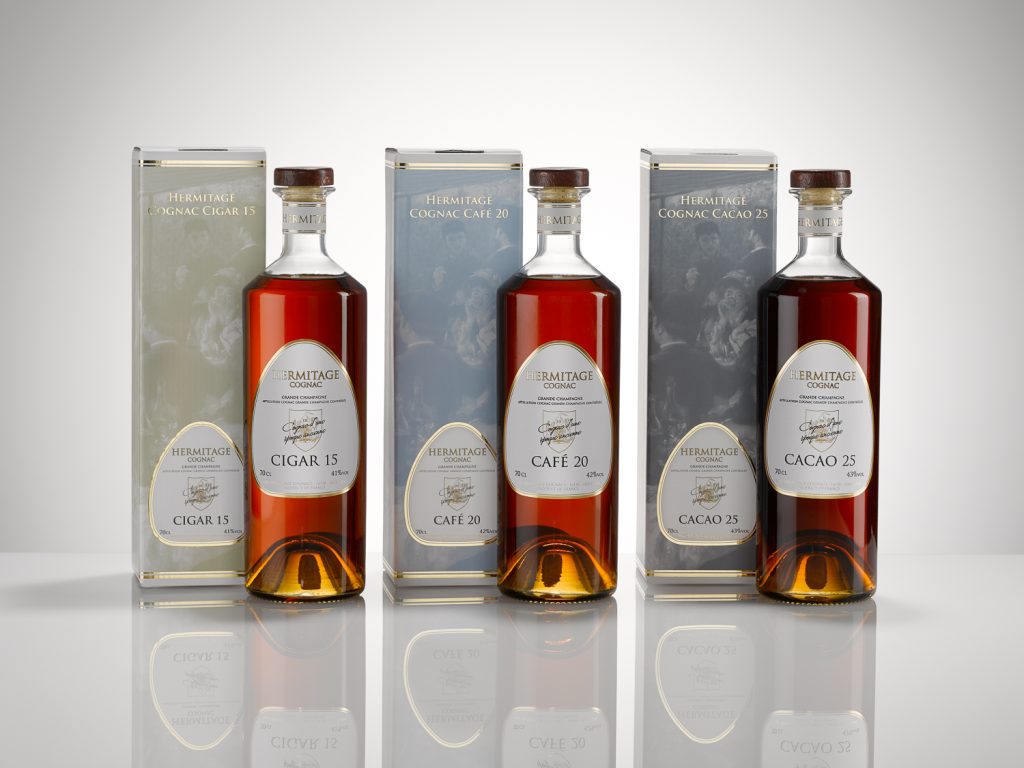
We were disappointed to read earlier this year that Cognac Renault has created ‘a new innovation – an expression specifically designed to pair with coffee’ – called Renault Avec.  Quite simply this is not the case. Hermitage Cognac launched its Café 20 Cognac in the Autumn of 2016 and it is already well established in the marketplace as a coffee accompaniment.   Provenance is not the only difference.  Renault have blended cognacs from 3 different crus aged between 3 and 8 years.  They are ‘not attempting to create a big, powerful cognac’ so have treated the barrels differently to affect the… Read more

Cognac and Chocolate – Food Pairing

Food pairing is all the rage right now, including with cognac.  Hennessy have created a whole dining experience to enjoy their latest cognac blend with a 4-course meal.  We never recommend doing this with vintage cognac but as a digestif, it does bring a special enjoyment.  Some cognacs have complimentary flavours which go well with after dinner courses, such as coffee (see The Bottle Story).  Chocolate is another post-dinner treat and also has flavours found in cognac, as reported recently by ‘The Telegraph’.  Our Hermitage Provenance 30 would be an excellent accompaniment with its rich flavours of chocolate and natural… Read more

Super XXO Cognac Classification Approved

The big cognac houses are well aware of the similarity of their products so the need to spice up their ranges is always evident. We have seen recently the efforts by some to add a cask finish to their cognacs; sherry casks have already been used by one house.  But the latest craze is to try and produce a super XO cognac called XXO.  Hennessy, who have the biggest sales of XO cognacs, have already launched an XXO in the Far East.  They tried to register it as a Hennessy name thereby denying other houses the opportunity to use the… Read more

Bartenders Champion Old Vintage Cognac

Vintage cocktails, made from rare and very old vintage cognac, are trending …… they are also extremely expensive!  Interest began with the World’s most expensive cocktail which was created in 2012 and sold for £5500.  It contained a 1788 Cognac, 1770 Liqueur and 1860 Orange Curacao.  Similar concoctions can now be bought at the very best bars in the world for similarly handsome prices. Cheltenham Festival also followed suit this year producing a cocktail containing 1937 Delord Armagnac, in memory of Golden Miller, Gold Cup winner 1932 – 1936. Very old (pre-Phylloxera) cognacs and Armagnacs are, by definition, incredibly rare… Read more

Brandyclassics News – Michelle Brachet Visits

It’s been a very busy start to the year with interesting cognac events in the diary and the arrival of yet more new stock. Following the BNIC’s launch of a new brand identity for the cognac appellation, they organised a trade-only Tasting event in London. Very well attended, our cognacs with age statements, under the Hermitage label, went down a storm.  The event was hosted by Michelle Brachet, cognac expert and educator, who we thoroughly enjoyed hosting when she subsequently visited us in Wiltshire. Another new Hermitage vintage cognac has just joined our handpicked range.  It was distilled in 1948… Read more

The XO Definition Has Finally Been Changed

With effect from 1 April 2018 any cognac classified as an XO must have been aged for a minimum of 10 years.  This change of XO Definition means that in the case of a blend, which many are, the youngest cognac used must now be at least a decade old.  This is a 4 year increase as previously only 6 years of ageing was sufficient for a cognac to qualify.  Regulatory body, the BNIC, comments that the change is designed to extend the quality positioning of XO cognacs and align them with market reality (some XOs are aged for 10… Read more

Hermitage 1968 Petite Champagne Cognac

Just arrived – Hermitage 1968 Petite Champagne Cognac. The mid 1960s produced some excellent cognacs from Petite Champagne and this one is no exception.  It needs to stand for a few minutes for the aromas of hazelnuts, brioche, bananas and gooseberries to develop.  This is a lighter style cognac, exhibiting many flavours initially of roasted hazelnuts with brioche and a hint of lime.  These develop slowly with banana, blueberries and a hint of strawberries with the zest of lime influencing the tail.  Distilled 50 years ago, it is a very special treat for someone celebrating their half century in 2018. … Read more

The Ancient Art of Tasting Armagnac

Armagnac is probably the oldest known wine spirit in the world but the art of distillation was introduced by the Arabs between 1411 and 1441.  In the department of France known as the Landes, they produced an agua ardente, or fire water, which was used initially as a therapeutic cure.  Tasting Armagnac for pleasure ensued when it was established that storing the spirit in barrels developed desirable flavours. Armagnacs are the earliest examples of distilled wines known in France.  Traditionally they are made using the Folle grape although others, including Colombard, Ugni Blanc and even more recently, the Baco all… Read more
