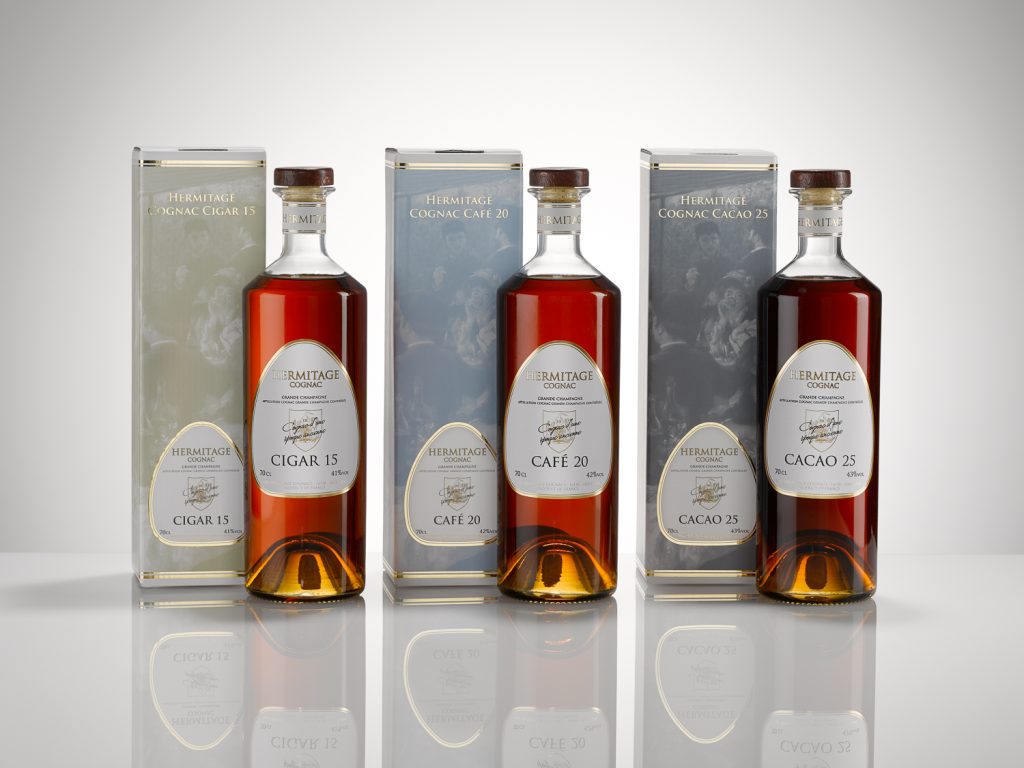
We were fascinated to read an interview with Bénédicte Hardy in ‘Frenchly’. Bénédicte is the fifth generation to be involved with the House of Hardy cognacs, although much of her time has been spent working in the US.
Entitled ‘Cognac’s return to Grace’, she describes the rich history of cognac and how in recent years, cognac has evolved into a symbol of both ‘rap stardom’ and ‘highbrow mixology’. Here at Hermitage, it is that history that we aim to bottle and so a summary follows:
In the 17th century, it was English, Irish, and Dutch négociants who really put cognac on the map as they had realised what an amazing resource the river Charente was for shipping their products worldwide. During the subsequent centuries, cognacs’ fortunes hit highs and lows, but always survived. The French Phylloxera crisis, for example, was eventually solved by turning to American root stock. Even two World Wars did not ruin the industry. During World War I, while men were conscripted, women were left to manage the vineyards and distillation by themselves. The work of these women became so significant that eaux-de-vie produced in 1914 is now known as part of the Ladies Vintage. And during World War II, while Nazi soldiers ransacked Champagne for all it was worth, a Cognac local, of German origin, Lieutenant Gustav Klaebisch, took it upon himself to protect the cognac cellars and vineyards from being pillaged.
Hermitage stocks cognac vintages harvested during both World Wars, but we are particularly proud of our Ladies Vintage, produced in 1914. A Masters Award winner, unsurprisingly, only a few bottles remain.

While Baijiu is the undisputed national spirit of China,
Did you know it was National Cognac Day last month? A relatively new addition to the annual calendar and originating in the United States of America, it is celebrated on the 4th of June. As with all popular, American activities it has become a worldwide event, so mark it in your diary ready for 2020! This year Jeanne O’Brien Coffey came up with 5 reasons to drink
During the years after the gold rush in the 1850s, brandy became the most popular spirit in Australia. French companies were quick to seize the opportunity and in 1870
M Restaurant has announced that it is to sell its bottle of 1894 cognac for over £6000 for a 25ml shot – that’s the price of cognac history. The bottle is reputedly the first blend ever produced by Jean Fillioux, who founded the
Not every cognac house has a Paradis – a designated area in the innermost recess of their cellar – but those that exist are steeped in history. Back in the early eighties, having discovered a cognac which I really liked, I went to the Charente to try and discover its origin. I ended up in Cognac’s twin town, Jarnac, standing in front of an elegant wrought iron gate with an imposing key. Behind it were about 100 very dusty bonbonnes, each with a chalk board describing what was in them. What an eye opener – they contained cognacs which dated from as early as 1805. Each bonbonne (a sort of demijohn in a basket), contained about 30 litres of prized spirits and was sealed with wax to maintain its superior qualities.
Many cognac families select a few of their finest cognacs for storage in the Paradis. The point when a cognac has gained all the benefit it can from the wood depends on many factors but ultimately, it is when the cellar master decides that it has reached its optimum quality. At this stage the cognac is put into glass bonbonnes and sealed so that the generations of gentle maturation in the barrel are preserved. A cognac that has lasted in oak without deterioration for perhaps 60, 70, 80 or even 90 years is going to be good, very good and will have developed the much sought after
On a recent trip to the Charente I took this picture of a rose bush at the end of a row of
During the 18th Century smuggling in Cornwall was a way of life. It is said that at its peak, more than 500,000 gallons of French brandy was smuggled in per year. This equates to more than two million bottles. Whole families were involved and the number of smugglers far outweighed the number of Excise men stationed along the coast to stop them. There was a strong incentive to continue since the cost of buying brandy legally, with Alcohol Duty paid, was five times greater than the cost of the contraband. It was often the case that even the judiciary, doctors and priests were in on the act as they provided the funds.
Most of the brandy came from the ports of La Rochelle and Rochefort and illegal shipments arrived regularly at Falmouth coves such as Helford, Gweek, Porthallow and Godrevy. The French were still reducing their wines for easier transportation to England, Ireland and Holland. The quantity of brandy shipped to England did much to support the French brandy industry during the 18th Century. However, by the early 1800s Customs had started to gain a level of control. Some smugglers were apprehended but juries were often reluctant to convict as many had connections with the trade. Even by the mid 19th Century, £millions were still being lost due to the Cornish smugglers evading tax.
Alcohol Duty is of course an important part of the British tax system and is calculated today at a cost of £28.74 per litre of pure spirit. A 70cl bottle of brandy at 40% alcohol by volume (abv) therefore attracts a duty of £8.05. Shipments of
There are six growing areas (crus) which are based on the soil features as described by the geologist Henri Coquand in 1860 and ratified by decree in 1938. They are Grande Champagne the second smallest cru with a growing area of 13,159ha, Petite Champagne with 15,246ha and Borderies the smallest cru with 3,987ha of vines. Fins Bois has 31,001 ha of vines, Bons Bois 9,308ha and Bois Ordinaires 1,100ha which includes the islands of Ré and Oléron.
soils on top of soft chalk from the Cretaceous. The limestone content from the surface down is said to be in excess of 60% in some places. Montmorillonite clay provides fertile soil with good structure and a high water reserve. Wines from these crus provide light, floral cognacs which require long ageing in casks to achieve full maturity. It is generally regarded that the cognacs from Petite Champagne are similar to those from Grande Champagne but with a little less finesse.